
• Menu
  • Skip to right header navigation
  • Skip to primary navigation
  • Skip to main content

Turtle Guardians

  • SHOP
  • DONATE

Mobile Menu

  • Home
  • About Us
    • Visit The Turtle House
    • Outcomes
    • Our Partners & Supporters
    • Work With Us
  • Research & Recovery
  • Help Save The Turtles
    • Volunteer
      • Be a Guardian this summer
      • TG Youth Leaders
      • Volunteer reporting forms
      • Turtle Guardian Chapter Leaders
    • All about turtles
      • Learning Centre
      • Turtle Identification
      • Helping a Turtle Across the Road
      • Threats to Freshwater Turtles
      • Dapper Snappers
      • Nests and Moms
      • How Old is That Turtle?
  • Kids Corner
    • Level 1 Guardians
    • TG Youth Leaders
    • Turtle Camp
    • Classes, Presentations, Workshops
    • School Curriculums
  • Report A Sighting
  • Other Ways You Can Help
    • Donate
    • Become a Friend
    • Symbolically “Adopt” A Hatchling
    • Our Prevention is Powerful Wish List
    • Shop
  •  
  • facebook
  • twitter
  • instagram
  • tiktok
  • SHOP
  • DONATE
  • Home
  • About Us
    • Visit The Turtle House
    • Outcomes
    • Our Partners & Supporters
    • Work With Us
  • Research & Recovery
  • Help Save The Turtles
    • Volunteer
      • Be a Guardian this summer
      • TG Youth Leaders
      • Volunteer reporting forms
      • Turtle Guardian Chapter Leaders
    • All about turtles
      • Learning Centre
      • Turtle Identification
      • Helping a Turtle Across the Road
      • Threats to Freshwater Turtles
      • Dapper Snappers
      • Nests and Moms
      • How Old is That Turtle?
  • Kids Corner
    • Level 1 Guardians
    • TG Youth Leaders
    • Turtle Camp
    • Classes, Presentations, Workshops
    • School Curriculums
  • Report A Sighting
  • Other Ways You Can Help
    • Donate
    • Become a Friend
    • Symbolically “Adopt” A Hatchling
    • Our Prevention is Powerful Wish List
    • Shop
  •  
TGRM

Since 2010 Turtle Guardians has been conducting research to answer pertinent questions affecting turtle conservation. We work collaboratively with volunteers, municipal road departments, provincial government bodies, and also private sector construction companies to gather data,  apply and test solutions to help recover populations, and to help outline best management practices.

Starting in 2024 we rebranded this arm of our work to showcase our efforts and are pleased to have launched a new research coproduction approach to support partnerships with academic institutions.

Current Research Efforts
Eggshell Integrity (Turtle Egg "Implosions")

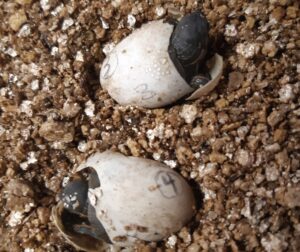
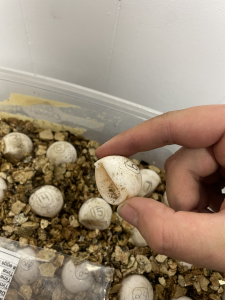
Beginning in 2021-2022 and continuing through recent field seasons, Turtle Guardians began observing an unusual phenomenon during nest monitoring and excavation. In some locations, turtle eggs were observed to rapidly collapse inward, effectively imploding within minutes of being uncovered. These events were often preceded by a faint “snap–crackle” sound. At the same time, nests from other areas examined on the same days did not show similar behaviour.

To better understand whether this was a localized or broader issue, we consulted with colleagues and several turtle incubation and rehabilitation programs across Ontario. At the time of our inquiries, similar observations had not been widely reported elsewhere in the province, suggesting the phenomenon may be geographically limited or associated with specific environmental conditions. In 2023 we began gathering data and documenting the implosions to support this hypothesis.

Eggshell integrity in turtles can be influenced by several factors, including maternal health, calcium availability, and local environmental conditions affecting soils and aquatic systems.

At present, the cause of these implosions remains unknown. Possible explanations include environmental conditions such as calcium levels and related pH, or other ecological or physiological stressors. Broader changes in environmental chemistry including shifts in calcium availability, road salt inputs, or contaminants that may influence mineral metabolism or reproductive physiology and are among the factors being considered.

These observations led us to develop a research hypothesis and in 2024 begin seeking scientific partners to investigate the issue more formally. We are pleased to be collaborating with researchers at the University of Manitoba to analyze samples collected through this work and explore the environmental and physiological factors that may contribute to these observations.

At the same time, we continue to seek insights from other regions and organizations working with turtles to better understand whether this phenomenon is occurring elsewhere and under what conditions.

By expanding monitoring, laboratory analysis, and collaboration with researchers, Turtle Guardians and The Land Between aim to better understand the conditions associated with this phenomenon and determine whether it represents localized variation or a broader emerging concern for turtle reproduction.

Population Ecology and Road Mortality

Turtle Guardians maintains one of the longest-running road ecology datasets for turtles in Canada, based on dedicated patrol routes monitored annually since 2017. Field data are collected using standardized protocols and include information on species, location, mortality, and body condition.

These long-term data allow the organization to examine patterns in turtle populations and road impacts across different landscapes. Current analyses focus on:
• Biomass and age-class structure across species, comparing populations across areas and landscapes.
• Population trends over time, including differences across primary, secondary, and tertiary roads, while accounting for landscape connectivity and habitat availability.

Additional analyses are ongoing to better understand the cumulative impacts of roads on turtle populations and to support conservation and recovery science.

The dataset is also used to identify:

  • nesting areas,
  • road mortality hotspots, and
  • key wildlife crossing locations.

These insights help guide mitigation efforts, including ecopassage placement, road stewardship initiatives, and targeted conservation actions. The database also provides background for Before After Control Impact studies.

Mark Recapture and Movement

Turtle Guardians maintains one of the longest-running road ecology datasets for turtles in Canada, based on dedicated patrol routes monitored annually since 2017. Field data are collected using standardized protocols and include information on species, location, mortality, and body condition.

These long-term data allow the organization to examine patterns in turtle populations and road impacts across different landscapes. Current analyses focus on:
• Biomass and age-class structure across species, comparing populations across areas and landscapes.
• Population trends over time, including differences across primary, secondary, and tertiary roads, while accounting for landscape connectivity and habitat availability.

Additional analyses are ongoing to better understand the cumulative impacts of roads on turtle populations and to support conservation and recovery science.

The dataset is also used to identify:

  • nesting areas,
  • road mortality hotspots, and
  • key wildlife crossing locations.

These insights help guide mitigation efforts, including ecopassage placement, road stewardship initiatives, and targeted conservation actions. The database also provides background for Before After Control Impact studies.

Spring Emergence_Snapping Turtles Study

Since approximately 2018, Turtle Guardians has received an increasing number of observations of Common Snapping Turtle hatchlings emerging in the spring, rather than in late summer or early fall when most hatchlings typically leave the nest. Many of these reports have come through our community-based monitoring initiative, the “Tiny Turtle Contest.”

In at least two documented cases, Turtle Guardians staff were called to investigate nests in the spring and excavated them to confirm the presence of live hatchlings that had overwintered in the nest.

We are currently mapping the locations of these observations and compiling environmental data to better understand the conditions associated with this phenomenon. In particular, we are examining relationships between nest substrate, snow cover, and shoulder season and winter temperature conditions to determine how these factors may influence hatchling overwintering and spring emergence.

As additional observations are reported, this work will help determine whether spring emergence is becoming more common and under what environmental conditions it occurs.

Overwintering Habitat Availability and Thresholds in Ontario’s Highlands

Turtle Guardians is conducting research to better understand the availability, characteristics, and thresholds of overwintering habitat for freshwater turtles in Ontario’s Highlands with a special focus on Common Snapping Turtles and secondarily on Blanding's Turtles. Overwintering sites are critical for turtle survival, as turtles remain submerged and largely inactive in aquatic habitats for several months each year.

This work focuses on identifying and mapping known overwintering locations and assessing the environmental conditions that support successful overwintering. In addition, we are examining how changing water levels and periods of low water may affect the suitability of these sites.

In addition to documenting the distribution of overwintering areas, this research aims to quantify the amount and quality of habitat required to support Common Snapping turtle populations, helping to identify thresholds of critical overwintering habitat within watersheds.

Understanding these thresholds has important implications for wetland conservation, water level management, and habitat protection, particularly in landscapes where water levels fluctuate or wetlands are altered. By improving our understanding of overwintering habitat availability and environmental limits, this work will help inform conservation planning and stewardship efforts across the region.

Ecopassage Fencing Design and Field Testing

Turtle Guardians has developed and is field-testing a prototype ecopassage jump-out fencing system designed to guide turtles safely toward wildlife underpasses while allowing animals that enter the roadway corridor to exit. The design builds on established wildlife exclusion fencing concepts while incorporating new materials intended to improve durability, stability, and ease of installation.

The system has been tested in field conditions over the past five years to evaluate performance under typical roadside stresses, including frost movement, soil shifting, and seasonal weather conditions. The design is intended to be rapid to deploy, cost-effective, and straightforward to maintain, with components that can be easily repaired or replaced when damaged.

The prototype is currently patent pending, and Turtle Guardians is continuing to refine the design through engineering review, including load-bearing assessments and corrosion testing, to better understand long-term performance in roadside environments.

This work supports the development of practical and scalable solutions for reducing road mortality and improving connectivity for turtles and other wildlife.

For research results, BMP's and observations, see our Resources section below.

For more details about or historic efforts and contributors, as well as upcoming and proposed research, see our Record and Acknowledgements section below.

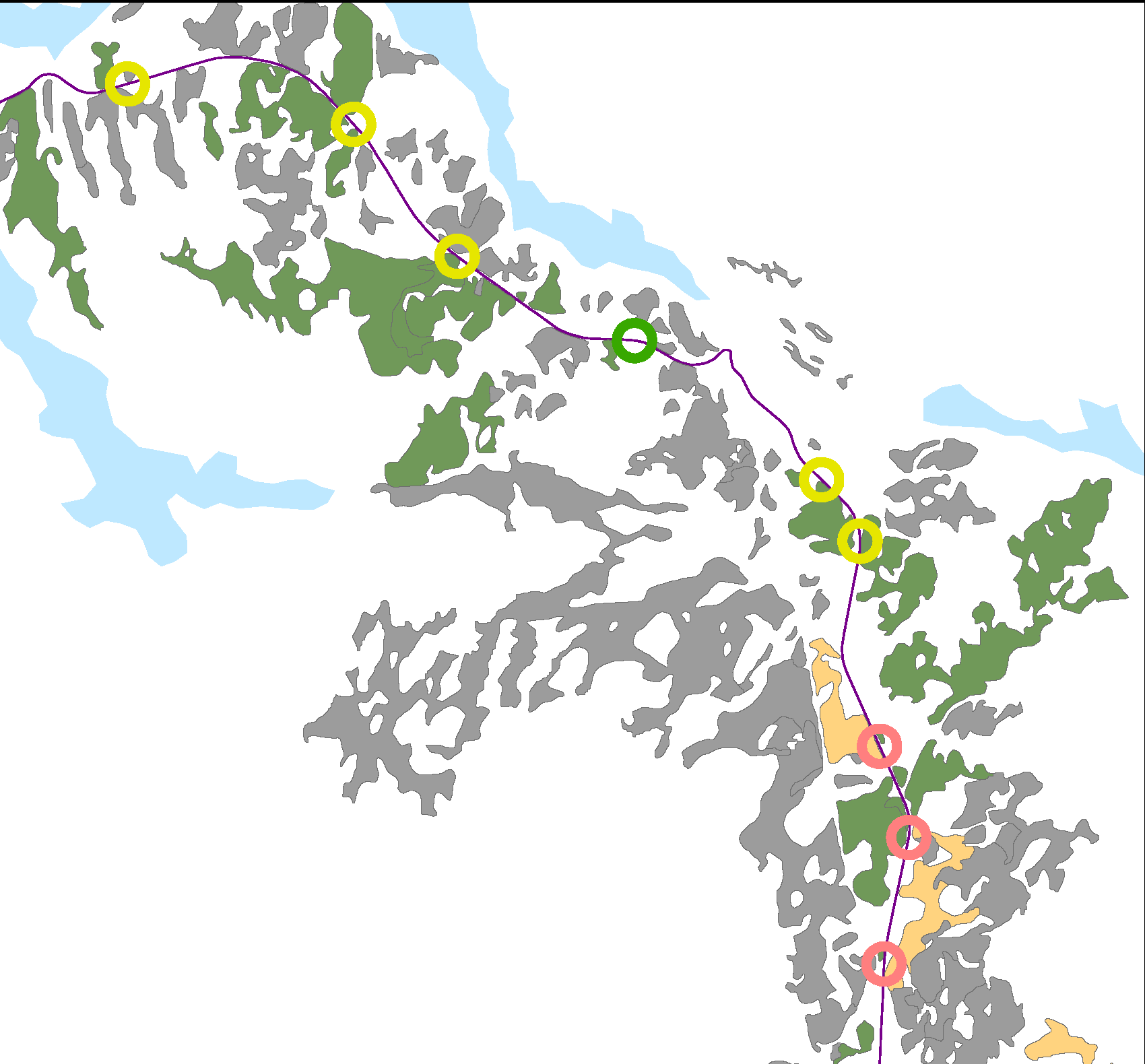
NSHS2-6-20250613
Sample Mapping 2 - Watercourse Intersection Only
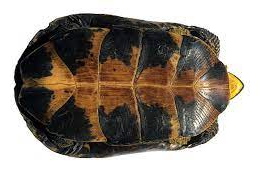
bltu plastron

Ongoing Mitigation Efforts

Nest Excavation, Incubation and Hatchling Release.  

Turtle Guardians trains volunteers and staff to recognize turtle nesting behaviour and to respond to reports of nesting females in vulnerable locations. Community observations and calls to our hotline help identify nests that may be at risk.

Nests located along primary roads, construction zones, or other high-risk areas are prioritized for intervention. In these cases, eggs may be carefully excavated and incubated ex situ to protect them from immediate threats.

Turtle Guardians operates one of the largest turtle incubation programs in Ontario, receiving and safeguarding hundreds of nests each year. This work is important because in many human-settled landscapes, the vast majority of turtle nests are destroyed by predators within the first 24–48 hours, largely due to increased populations of raccoons, skunks, and other mesopredators that thrive near roads and human development.

Freshwater turtles are particularly vulnerable because they are long-lived species that take many years to reach maturity. Population stability depends on occasional successful recruitment of hatchlings. By protecting vulnerable nests and supporting hatchling survival, incubation programs can help maintain local turtle populations where natural nest survival has become extremely low.

These efforts help offset the combined impacts of high nest predation rates and road mortality, supporting hatchling recruitment in areas where natural nest success is limited.

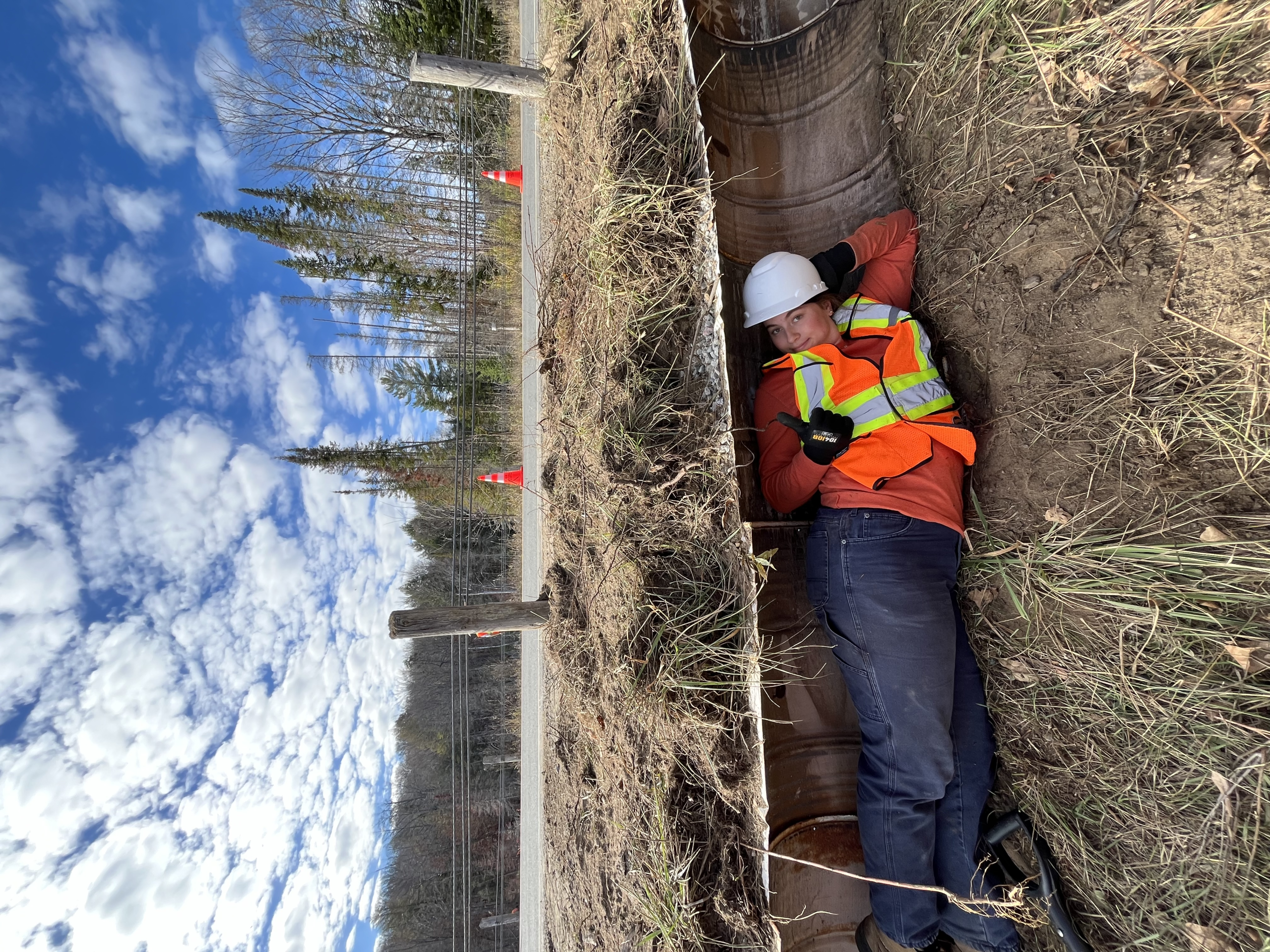
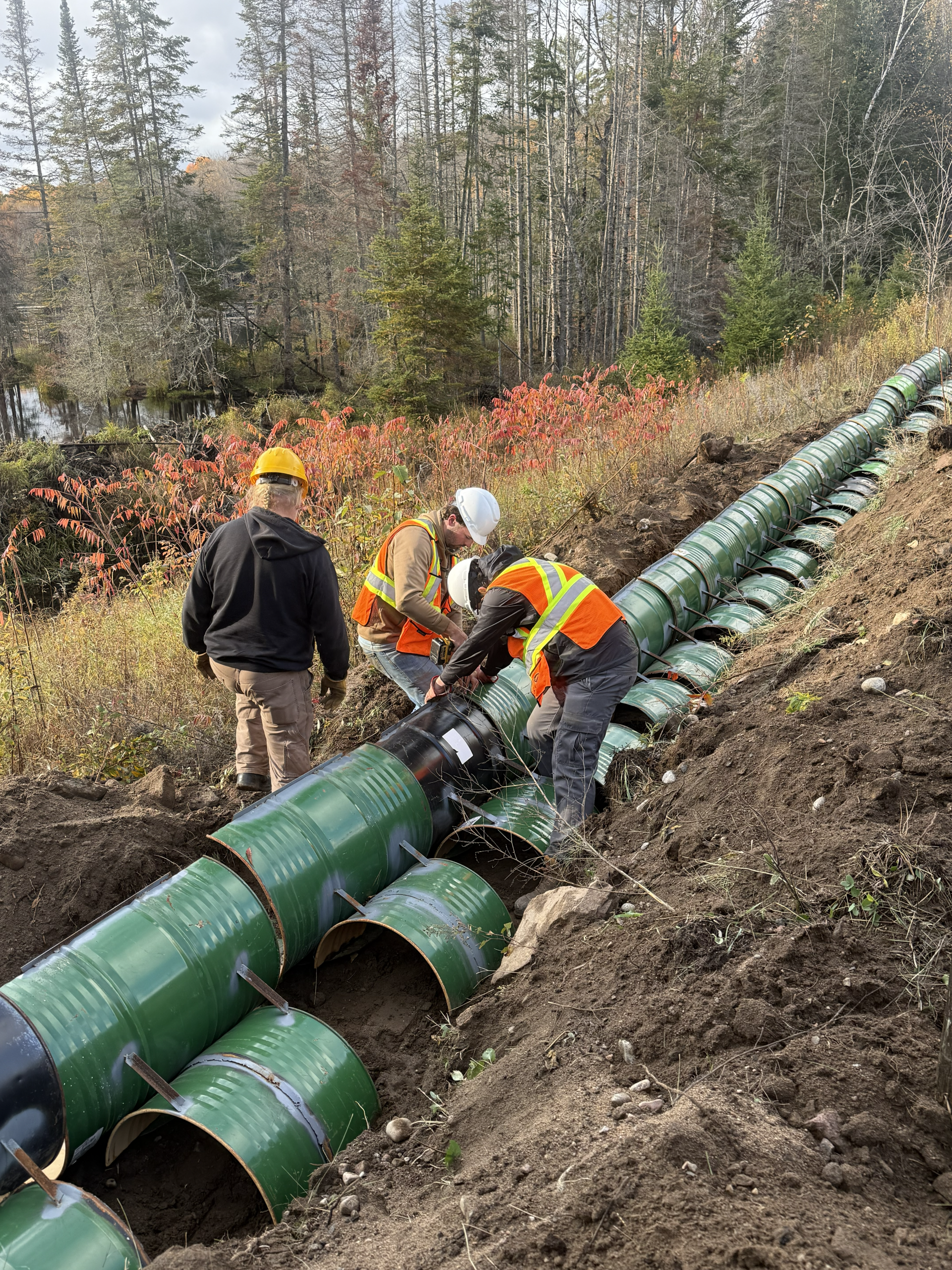
Durable Jump out and Exclusion Fencing for Ecopassage Installations and Alternative Nesting Mounds.  

Ecopassages are tricky, and selecting fencing is key.

Lateral fencing, if not bounding the entire wetlands and crossing areas, can lead to increased mortality, and even some arch shaped fencing creates similar issues while also breaking down or shifting.

Turtle Guardians has been designing and testing alternative, cost effective fencing since 2019. This fencing is both durable and it can be backfilled to ensure any animal can exit the roadway, while also being a fail safe option. The fencing is also inexpensive and easy to produce, while the individual sections are easy to maintain and also follow the road sinuously.

Any ecopassage project or fencing exclusion project should be accompanied by alternative nesting options. We have been testing and installing these alongside our mitigation projects.

To date, four ecopassage and mitigation projects have been installed, and the fencing solutions proven. Support from Eastern Georgian Bay Initiative, the Species at Risk Stewardship Fund, ECCC and the Bernard and Norton Wolfe Family Foundation have been essential to this success.

"Crossing Guards" and "the Turtle Way"

Direct mitigation and threat reduction through volunteer and staff onsite presence cannot be undervalued. We work with community volunteers who patrol roads. Also, in areas of high mortality that are not feasible for ecopassage installations and near urban areas, the charity is working with communities to engage volunteer patrols called "Crossing Guards" and community level efforts with fun branding and green painted symbols across road areas called "the Turtle Way". We use "softer" BACI studies to assess the value of these efforts.

Training, Design and Assessments

We provide training to stakeholders for identification, data collection, handling techniques and also mitigation.  We also provide assessments of critical and important habitats, mitigation and ecopassage potential. We have also worked in partnership with development companies to integrate habitat features and best practices in development areas.
darian and ecopassage
IMG_7364
hatchlings 2

Municipal Road Patrols 

In partnership with municipalities, we "sweep" roads scheduled for maintenance and improvements for turtle nests, to support them in mitigating harm to nests.

Signage 

In areas of high mortality that are not feasible for ecopassage installations or exclusion fencing, the charity designs and installs standard and also unique signage including billboards.

Research Co-Production

Data Sharing, Shared Research and Authorship Conventions

The Land Between and Turtle Guardians maintain extensive long-term datasets and active research programs, and, together with our colleagues, are advancing work on complex conservation questions that require deeper analysis and cross-institutional collaboration. To support this next phase, we are preparing to formalize research partnerships with universities and research institutes across North America.

We are currently developing collaborative frameworks and partnership models, including clear policies, that recognize and respect all contributions, uphold institutional and academic standards, and ensure reciprocal benefits and outcomes for partners, students, and communities. This work is being informed through consultation with universities, professors, and disciplinary experts to ensure alignment with research ethics, authorship norms, data stewardship expectations, and funder requirements.

Our approach is grounded in transparency, accountability, and fairness. As these frameworks are finalized, we will make our policies and partnership opportunities publicly available to support strong, ethical, and productive collaborations that advance conservation outcomes at scale.

Record and Acknowledgements

  • 2007 - Assessing Blanding's relative abundance across The Land Between region- and placement of crossing signs.
  • 2010 - Identification of turtle mortality hotspots across the Land Between bioregion and characterization of mitigation options. Ongoing.
  • 2016 - Basking surveys (support for overwintering analyses).
  • 2016 to 2025 - Population ecology research-relative to road density and development impacts. Currently analyzing.
  • 2017 - Plastron identification to estimate Blanding's turtle movements and recapture. Ongoing.
  • 2018 - Data collection from our "Tiny turtle contest" of spring emergence of Snapping turtles. Ongoing.
  • 2018 - Incubation success and anomalies. Ongoing.
  • 2019 - Design of innovative ecopassage fencing. Testing of prototype durability.
  • 2022 - Turtle egg implosion hypothesis- preliminary formation.
  • 2023 - Turtle egg implosion data collection relative to 2022 hypothesis. Ongoing.
  • 2023 - Painted turtle bridge photo recognition. Ongoing.
  • 2023 - Alterative nest mound pilot (Blanding's turtles).
  • 2025 - Overwintering habitat availability of Snapping turtles. Ongoing.
  • Upcoming: Willingness to use analysis of ecopassage fencing prototypes.
  • Proposed: Hesitancy in juvenile turtles related to perceived or actual obstacles.
  • Pending: Movement of adult turtles in response to anthropogenic footprints.
  • Withdrawn: Response to pheromone cues by hatchlings.

From 2017 to 2025 Turtle Guardians has worked independently to lead these research efforts, however our efforts would not be possible without mentorship and guidance provided from Kari Gunson, EcoKare International, and Jeff Hathaway, Scales Nature Park.  We are also grateful to Dr. David Lean who is our current advisor on discovering the reasons for turtle egg "implosions". We would also like to acknowledge students that have contributed through programs such as Ulinks, and Trent Centre for Community Based Education, as well as ecology students under Dr. Stephen Hill.  We acknowledge a partnership from 2011-2013 with Haliburton Highlands Land Trust and Glenside Ecological to assess ecopassage potential in Haliburton Highlands. In 2026, we would also like to acknowledge Stephan Kohout for his current research for the program on legislation levers for protecting turtles in Ontario. 

We would like to acknowledge the significant contributions of our staff in these efforts:

  • Kendra Chalmers - Sept 2010-2013
  • Jaime Kearnan - May 2016-April 2022
  • Daniel Grenon - May 2016-August 2022
  • Angela VanderEyken - May 2018-August 2020
  • Kristyn Bennett - May 2020-September 2022
  • Grace Wiley - May 2020-January 2025
  • Michaela Bouffard - April 2024-Jan 2026
  • Meghan Ward - wetland focused in 2023 and 2024; TGRR focus October 2025-present
  • Kyle Miller - January 2026-present

In 2024 the charity began exploring partnerships with Universities in research. We have been drafting a research, authorship, and IP policy which will be available soon. For more information on our research and coproduction, please contact us. 

Resources

Observations and BMPs

Post Installation Success
Ecopassage Prioritization- From Mapping to Mitigation
Review of HDPE Use in Road Threat Mitigation Projects
Low Cost Durable Solutions for Ecopassages
Road Mortality Mitigation BMP
Artificial Nesting Mound BMP
Road Maintenance_Mitigation for Nests

Technical Videos

The Needs for a Low Cost, High Quatlity Solution

Ecopassage and Road Mortality Mitigation Considerations- with EcoKare Intl.'s Kari Gunson

Ecopassage and Road Infrastructure Maintenance- With EcoKare International's Kari Gunson

Contact us

Search

Site Navigation

  • Home
  • How to Help Turtles
  • Learning Resources
  • Donate
  • Shop
  • Events Calendar
  • Contact

Our Partners

Join Us at Turtle Stories

Contact Turtle Guardians by calling 705-457-1222 or texting 705-854-2888

Copyright © 2026 Turtle Guardians · Email Us · Privacy Policy

Site Development by TechnicalitiesPlus Inc.


Loading Comments...