

Road Ecology and Threat Mitigation
Roads are one of the greatest threats facing turtles across North America. Turtle Guardians works actively on roads and in the field to document this threat, understand its impacts on turtle populations, identify priority locations for action, and develop effective, affordable and practical solutions that can be applied broadly.
What We Do
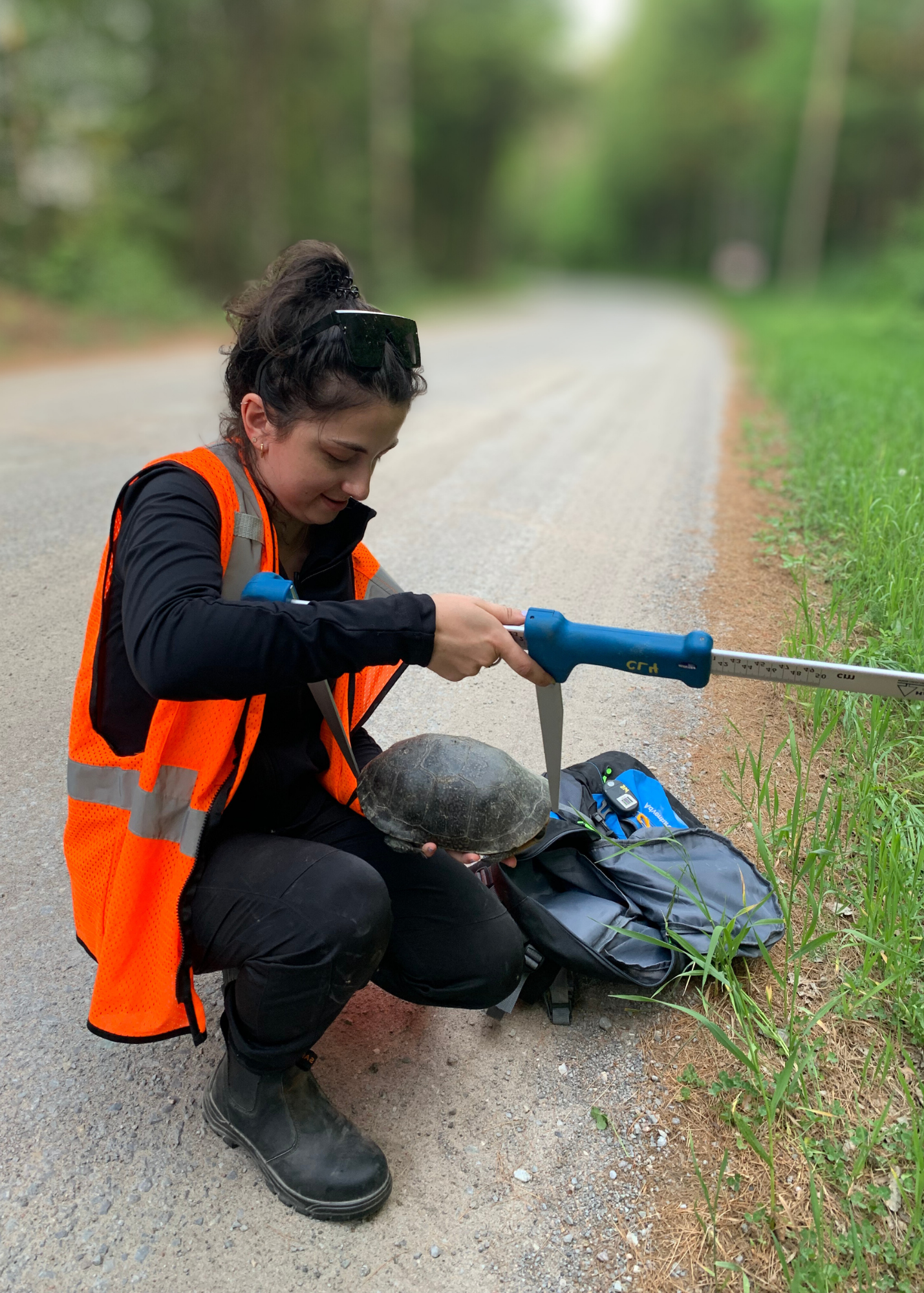
We patrol roads throughout turtle season, documenting live and dead turtles and collecting data on species, sex, age class, morphometrics, condition and location. We record injuries and mortalities, nesting activity and nest locations, movement patterns and mortality hotspots, while identifying and assessing potential sites for road mitigation and ecopassages.
We then put this knowledge into action. We assess and prioritize sites; design, install and monitor ecopassages and exclusion fencing; install turtle crossing signs; create alternative nesting areas to reduce roadside nesting; and test and improve mitigation in the field.
We also design new solutions where existing approaches are not practical or affordable. Turtle Guardians has developed a unique ecopassage prototype, which we have installed and tested in partnership with municipalities and road engineers. Through field monitoring, we evaluate how turtles interact with these systems, identify design and maintenance issues, and continually improve their effectiveness, durability and practicality.
Our goal is not simply to demonstrate that road mitigation can work, but to develop effective, affordable and adaptable solutions that municipalities and communities can implement broadly across the landscape.
Why It Matters
Turtles are especially vulnerable to roads because they are long-lived, mature slowly and depend on high adult survival. Repeated losses, particularly of adult females, can contribute to population decline and reduced recruitment.
Roads can also separate wetlands, nesting areas and other habitats turtles need throughout their lives. Effective mitigation must therefore reduce mortality while maintaining safe movement between habitats.
Our Approach and Research
Our Approach & Research
Our road ecology research uses long-term field data, experimentation and monitoring to understand the scale and impacts of road mortality on turtle populations, where intervention is most needed, and what mitigation solutions are most effective.
We investigate:
- patterns and trends in road mortality
- changes in turtle populations, age classes and recruitment
- relationships between road mortality, habitat loss and landscape change
- mortality hotspots and priorities for mitigation
- turtle movement and behaviour around roads, fencing and crossings
- which mitigation approaches work, where and under what conditions
- ecopassage and fencing design and effectiveness
- durability, maintenance and long-term performance
- failures and unintended consequences that can inform better solutions
Our approach is iterative: we collect data, identify priorities, design and test solutions, monitor how they perform, learn from the results and improve them.
We combine our own research and field testing with published science and collaboration with researchers, engineers, municipalities and conservation practitioners to develop better road mitigation and help direct turtle recovery.
A New Ecopassage Fence Design
In 2018, Turtle Guardians founder Leora Berman designed a new modular exclusion and jump-out fencing system to overcome some of the cost, installation, durability and wildlife-movement challenges associated with conventional turtle road mitigation. Development and testing began in 2019, with support from the Eastern Georgian Bay Initiative, Species at Risk Stewardship Fund, Environment and Climate Change Canada, and the Bernard and Norton Wolfe Family Foundation.
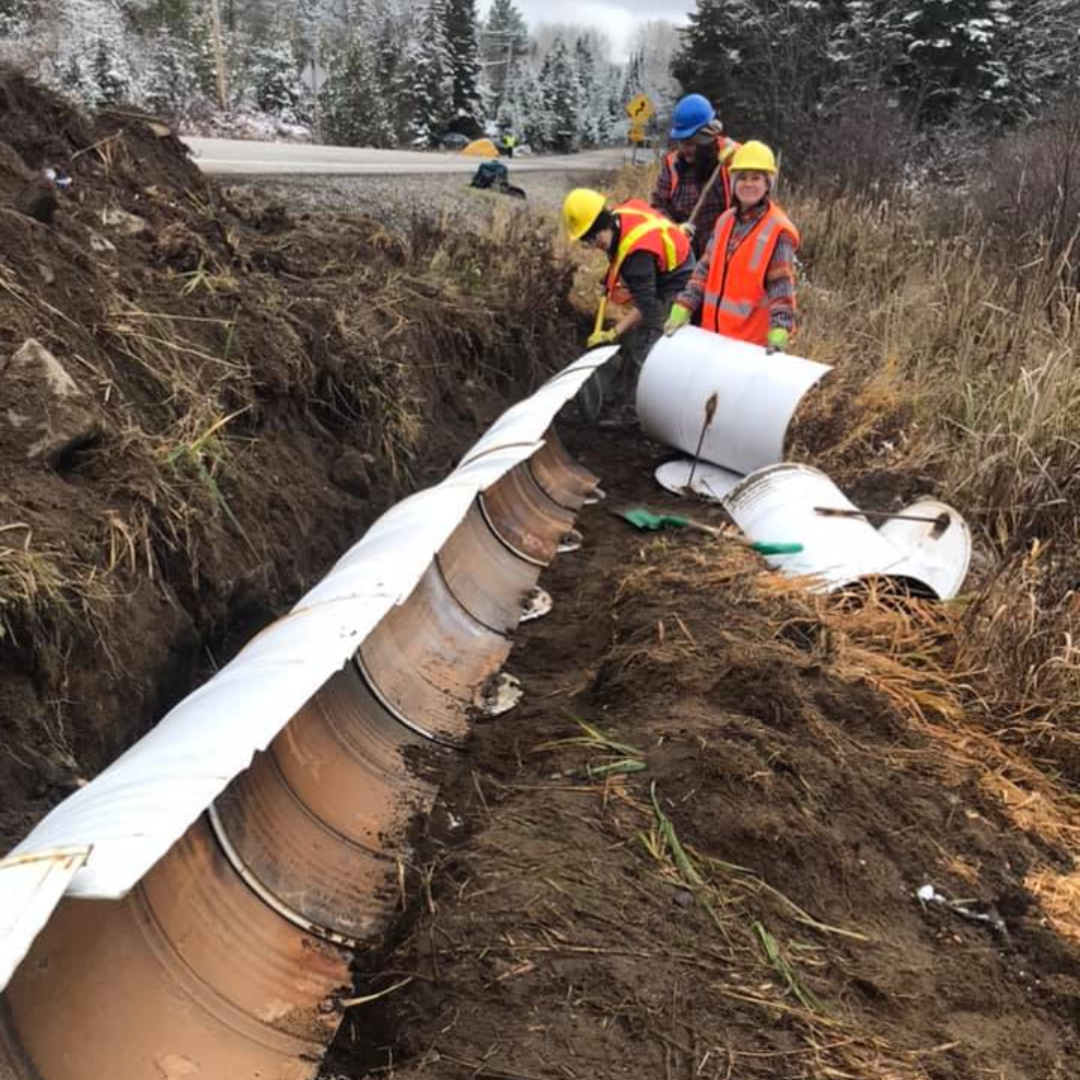
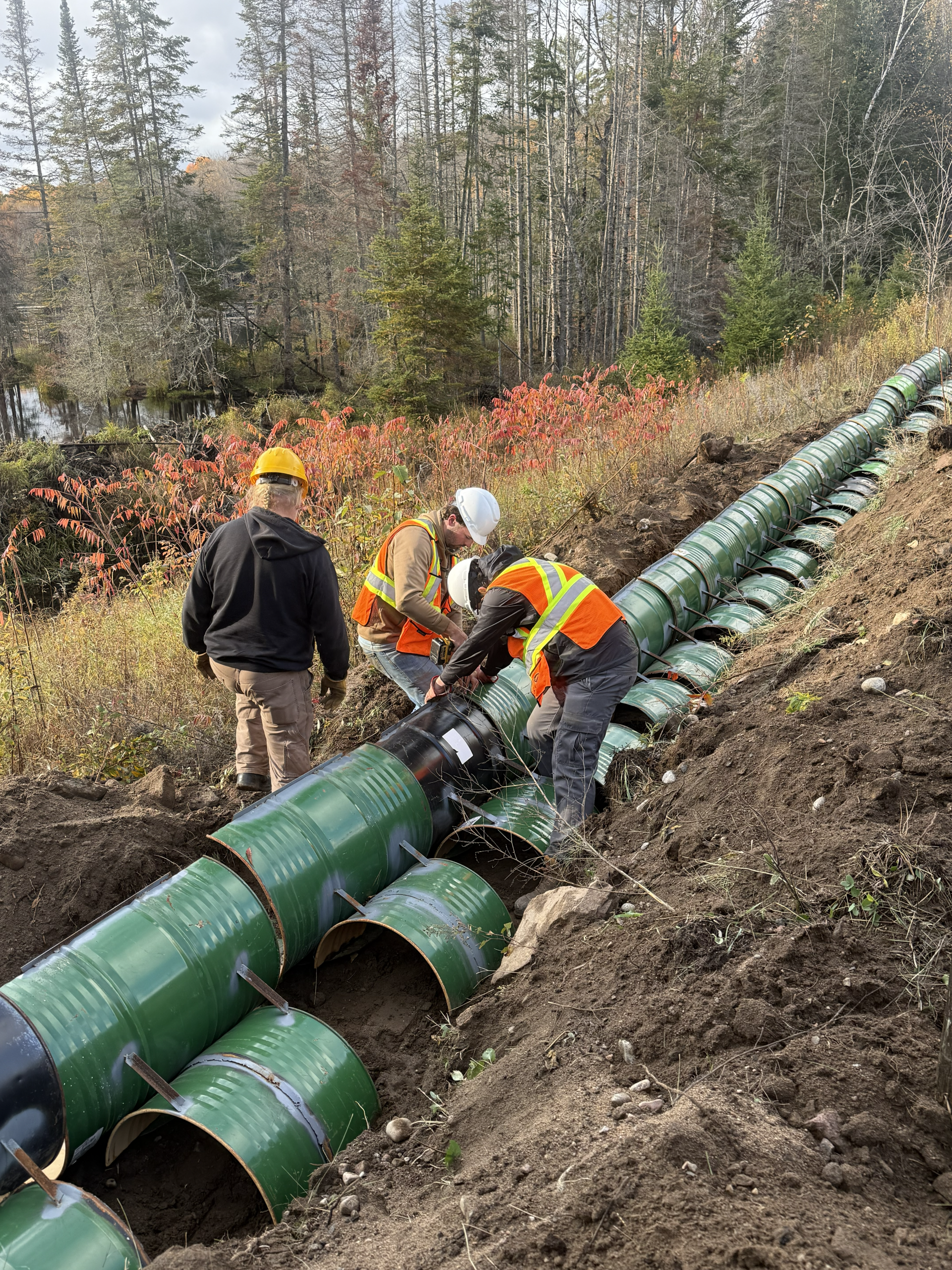
The design uses sections of half-round barrel forms to create a durable, affordable and flexible barrier that can follow the curves and contours of roads. Its smooth, sinuous shape safely redirects turtles while avoiding exposed mesh that can entangle or injure snakes and other wildlife.
Importantly, the system can be backfilled, allowing the surrounding landscape to remain permeable to wildlife that may be found on roads while continuing to exclude turtles from the roadway. This provides a fail-safe that can reduce risks when fencing is damaged, displaced or otherwise compromised, or in other circumstances where turtles and other wildlife enter the road.
The prototype was first installed with approval from the Haliburton County Roads Department in 2020 and has now undergone five years of field testing and monitoring under real roadside conditions, including seasonal weather, frost movement and shifting soils. Since its initial development, the approach has been incorporated into multiple Turtle Guardians ecopassage and road-mitigation projects, allowing us to assess durability, installation and maintenance requirements, wildlife interactions and performance over time.
The prototype is currently patent pending and continues to undergo engineering review and testing, including load-bearing assessments and corrosion testing, to further document its long-term performance in roadside environments.
The result is a solution that is effective for turtles, safer for other wildlife, durable, adaptable to real-world roads, easy to install, maintain and even remove, and affordable enough to be implemented broadly.

Acknowledgements
Turtle Guardians' road ecology and mitigation work has developed over many years through field research, design, testing, monitoring and collaboration. We gratefully acknowledge the individuals, municipalities and partners who have contributed their expertise and assistance to specific aspects of this work.
Ecopassage Fencing Design, Development & Field Trials | 2018-present
Design and Research Lead: Leora Berman
Leora Berman designed Turtle Guardians' modular exclusion and jump-out fencing prototype in 2018, with development and trials beginning in 2019. Work has included prototype design and refinement, field testing of stability, durability and effectiveness, backfilled and wildlife-permeable applications, and development of installation and mitigation guidance.
We gratefully acknowledge David Gafni, engineer, who assisted in increasing durability of the design, and to the road departments of Haliburton County, City of Kawartha Lakes and Peterborough County for their partnerships in advancing field applications and trials.
Sabrina Hasselfelt and Angela VanderEyken (2019-2022): Assisted in assessing countless potential ecopassage sites across Ontario's Highlands to shortlist candidate sites, test alternative fencing materials, aid in overall assessment of potential, and construct best management practices.
Michaela Bouffard (2025): researched and prepared a proposed post-installation study examining turtle willingness to use crossings, and led the installation of one prototype fencing system. She also assisted by preparing technical drawings documenting Turtle Guardians' existing ecopassage designs.
Alternative Nesting Mound Pilot | 2023–present
Lead: Leora Berman
Turtle Guardians initiated field trials of alternative nesting mounds for Blanding's turtles in 2023 as a complementary approach to road mitigation. The work examines nesting-mound placement, use and substrate characteristics and continues to inform recommendations for future installations.
Kari Gunson, Eco-Kare International: technical advisor.
Proposed Juvenile Turtle Behaviour Research | 2025–present
Lead: Leora Berman
Following the discovery of two deceased juvenile turtles adjacent to exposed portions of ecopassage fencing in 2025, Turtle Guardians identified a new research question concerning juvenile responses to actual versus perceived barriers. Proposed research will investigate whether fencing configurations can create physical obstacles or behavioural hesitation and how these responses should inform future mitigation design.
Best Management Practices & Technical Reviews | 2017–present
Our BMPs and technical resources combine ongoing literature review with knowledge gained through field installation, monitoring and experiential documentation.
Leora Berman | 2017–present: ecopassage specifications and installation guidance; development and documentation of Turtle Guardians' road-mitigation approaches; Blanding's turtle alternative nesting-mound BMPs; and BMPs for protecting turtle nests during routine road maintenance.
Sabrina Hasselfelt | 2019: literature review of nesting-mound design and best practices; assisted in the testing of ecopassage fencing tie in materials. Municipal outreach.
Angela VanderEyken | 2020- 2022: review of best practices in road ecology; review of potential ecopassage sites. Municipal outreach.
Michaela Bouffard | 2024-Jan 2026: review of HDPE use in road-threat mitigation designs; review comparing Turtle Guardians' low-cost ecopassage designs with standard lateral fencing approaches; research proposal for post-installation success monitoring and turtle willingness to use culverts; and review of road-mortality mitigation and best management practices.
Special Thanks
Since 2017, Leora Berman has led and coordinated Turtle Guardians' long-term work in turtle road ecology, nesting, incubation, movement, mortality and mitigation across Ontario's Highlands and surrounding regions. This work has included the development of research scopes, field methodologies, monitoring protocols, ecopassage designs and testing, community science frameworks, and the generation of rigorous long-term datasets to to inform conservation priorities, applied mitigation, and to assess trends.
Our work has been strengthened by the guidance, mentorship and collaboration of many valued experts and partners. We are especially grateful to Kari Gunson of Eco-Kare International, Jeff Hathaway of Scales Nature Park, David Gafni in engineering and Dr. David Lean in toxicology for sharing their expertise and advice over the years.
We also gratefully acknowledge the contributions of students, interns and emerging researchers, including those participating through U-Links and the Trent Centre for Community-Based Education, as well as the many staff and volunteers who have contributed to field monitoring and data collection.
We further recognize an early partnership from 2011 to 2013 with the Haliburton Highlands Land Trust and Glenside Ecological Services to assess candidate ecopassage sites and to develop BACI study designs in the Haliburton Highlands.
Lessons From the Field
Years of site assessment, installation and monitoring have taught us that successful road mitigation depends as much on landscape, hydrology, fencing and long-term adaptability as it does on the crossing structure itself. Our work continues to evolve as we test solutions and learn from what happens in the field.
Assess the Whole Landscape
- Selecting the right location is fundamental. We have developed methods for assessing potential ecopassage sites both remotely and on the ground, supported by the expertise of road ecologist Kari Gunson of Eco-Kare International.
- Assessment considers not simply where turtles cross, but surrounding wetlands, topography, existing drainage structures, road configuration, nesting habitat, barriers and the feasibility of creating effective exclusion.
Continuous Exclusion Can Be Difficult and Critical
- Ontario's Highlands present particular challenges. Extensive and complex wetlands occur within an undulating landscape where exposed rock, driveways crossing wetlands and other interruptions can make continuous conventional fencing difficult or impossible.
- A significant investment in an ecopassage can be undermined if turtles can still access the road. Once on the roadway, lateral fencing can also prevent turtles from leaving safely.
- This has reinforced our focus on continuous exclusion combined with a fail-safe means of escape. Where appropriate, our approach uses fencing below the road shoulder or backfilling to create a wildlife-permeable ramp while maintaining turtle exclusion. See our Design Specifications in Reports & Resources.
Only a Small Proportion of Sites Are Straightforward
- Through our road ecology work, we mapped more than 900 potential turtle crossing sites and evaluated approximately 140 for mitigation.
- Our assessment found that sites without major landscape obstructions and with existing culverts suitable for potential adaptation represented only about 5% of the crossing sites assessed. And feasibility alone does not mean that a site is a conservation priority: suitable infrastructure may not coincide with areas experiencing the greatest turtle mortality.
- This reinforces the need to consider both ecological priority and practical feasibility when deciding where to invest in mitigation. See our site assessment report below.
Ecopassages Need to Adapt to Changing Water
- In much of our landscape, hydrology is strongly influenced by beavers. Wetlands can flood or drain rapidly, changing conditions around fencing and crossings.
- For this reason, the ability to remove, reposition or adapt sections of mitigation can be important. Our modular fencing allows sections to be removed when conditions change, while adaptable opaque materials, including products such as Animex fencing, can be used for tie-ins around culverts where flexibility is required.
Backfilling and Permeability Matter
- Monitoring has also shown us why fail-safe design is so important. At one installation, erosion removed some of the backfill around a section of fencing and two juvenile turtles were subsequently found deceased.
- The observation reinforces the importance of maintaining backfill and permeability, but it also raises an important unanswered question. Did the exposed structure create a physical barrier the juveniles could not overcome, or did they perceive it as a barrier and continue moving alongside it?
- We believe this warrants further behavioural research. Understanding how juvenile turtles perceive and respond to different fencing forms could improve mitigation design well beyond this individual installation.
Alternative Nesting Areas Need to Mimic Natural Conditions
- Road mitigation should also consider nesting habitat. Where turtles are attracted to road shoulders for nesting, we have installed and tested alternative nesting mounds alongside mitigation projects.
- Our initial mounds using a 50:50 sand and gravel mixture received little or no nesting use during their first two years. While turtles may take time to adopt newly created nesting areas, our observations also raise questions about substrate.
- Natural nesting sites provide more than drainage. Moisture, fines and organic material may also influence site suitability, particularly under increasingly dry summer conditions. Based on our observations and review of the available evidence, we recommend that artificial nesting substrates more closely mimic natural nesting conditions, including appropriate organic material and fines, rather than relying solely on highly drained sand-and-gravel mixtures.
- See our Information and Experimental Report on Alternative Nesting Substrates below.